
THE LEARNING SCIENCE CONFERENCE 2026
Where Research Meets Practice
Clark Quinn 〰️
Paul Kirschner 〰️
Elizabeth Bjork 〰️
Robert Bjork 〰️
John Sweller 〰️
Dawn Snyder 〰️
Connie Malamed 〰️
Tom McDowall 〰️
Elham Arabi 〰️
Matt Richter 〰️
Kat Koppett 〰️
Nidhi Sachdeva 〰️
Ingeborg Kroese 〰️
Stephanie Moore 〰️
Anne Brafford 〰️
David Grad 〰️
Page Chen 〰️
Elizabeth Dalton 〰️
Nuri Jeong 〰️
Clark Quinn 〰️ Paul Kirschner 〰️ Elizabeth Bjork 〰️ Robert Bjork 〰️ John Sweller 〰️ Dawn Snyder 〰️ Connie Malamed 〰️ Tom McDowall 〰️ Elham Arabi 〰️ Matt Richter 〰️ Kat Koppett 〰️ Nidhi Sachdeva 〰️ Ingeborg Kroese 〰️ Stephanie Moore 〰️ Anne Brafford 〰️ David Grad 〰️ Page Chen 〰️ Elizabeth Dalton 〰️ Nuri Jeong 〰️
NEW THIS YEAR!
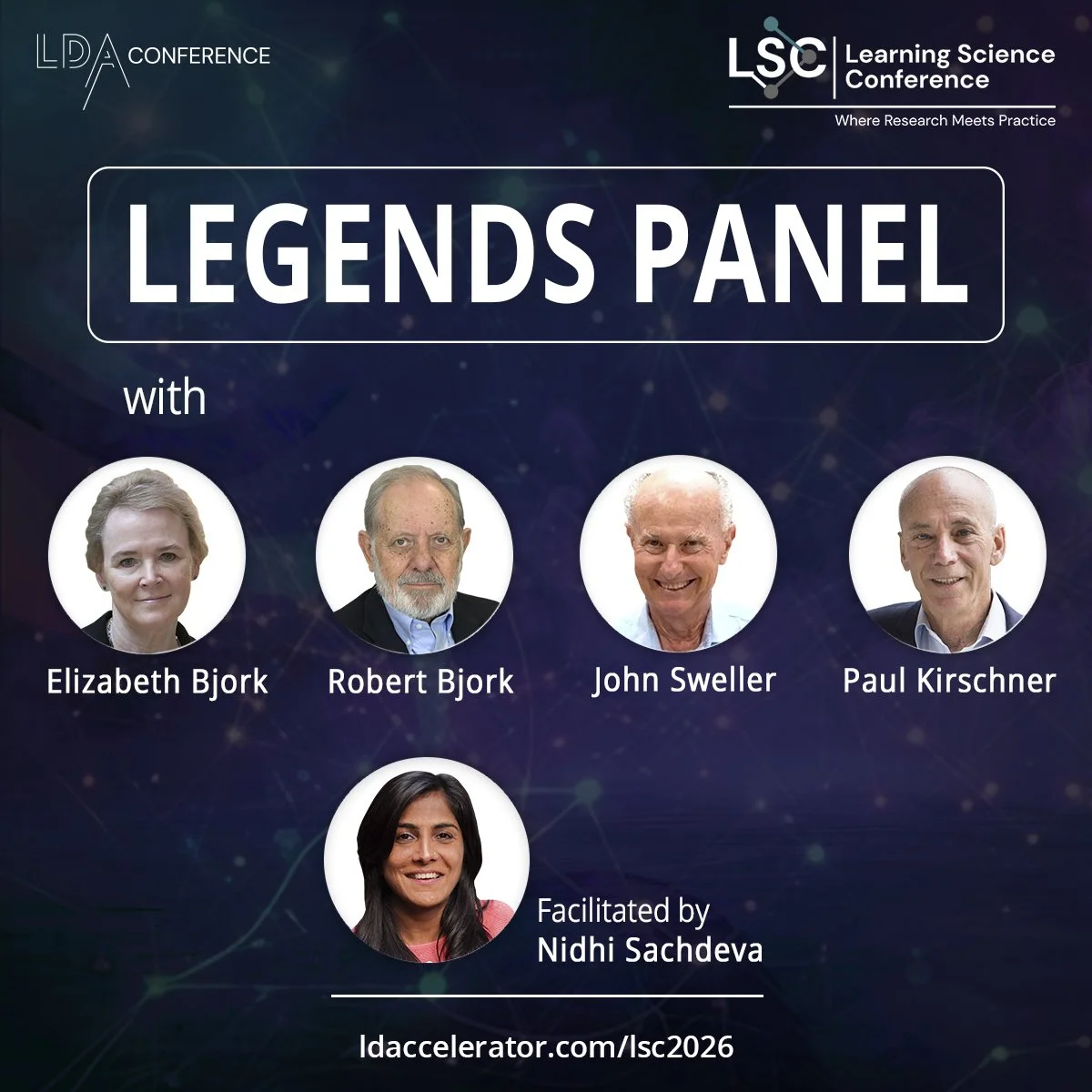
This year, for the first time, a Legends Panel bringing together four of the most influential researchers in learning science: Elizabeth Bjork, Robert Bjork, John Sweller, and Paul Kirschner. December 9. Full conference schedule below.
OVERVIEW
“You want to design and implement better learning solutions. But how do you develop the skills to do it right? You want to dive deeper into evidence-informed practices but don’t know where to start?”
Bridge the gap between research and practice: join the Learning Science Conference 2026.
The Learning Science Conference is Learning Development Accelerator’s signature event, focused on the foundational science behind how people learn, and what that means for learning design decisions.
Each year, we go deep into the mechanisms that shape learning: memory, retrieval, cognitive load, motivation, feedback, assessment, and more. Not as abstract theory, but as practical insight you can use to design more effective learning experiences.
This conference is designed to ground new learning professionals and to refresh, sharpen, and deepen the judgment of experienced designers and leaders. Because without an understanding of learning science, everything else we do in L&D rests on shaky ground.
During the conference, you will:
Deepen your understanding of how learning happens.
Gain readily applicable evidence-based tools.
Network with leading thinkers and practitioners.
Whether you design, deliver, manage, or support learning, you’ll leave with actionable insight and renewed confidence in creating learning that truly sticks.
WHAT’S IN IT?
The Learning Science Conference is where learning professionals come together around evidence-based L&D.
The conference is a one-month experience that includes:
9 practical topics to explore the nuances of learning presented by the expert speakers
5 special events to spark reflection and expand your perspective
Asynchronous and live, online sessions
A dedicated forum to interact with speakers and fellow attendees
The LSC Cafe. A participant-led space for informal conversations and connection.
Our handpicked speakers will dive into the science of how learning happens, covering: encoding, retrieval, emotion, motivation, multi-media, social learning, assessment & measurement, feedback, and more. You’ll walk away with the insights and tools you need to design solutions that are engaging and effective.
And because the conference is paced intentionally, you’ll have time to watch sessions, reflect, try ideas in your own context, and then join the live sessions with questions—so you can learn from peers and get feedback from experienced experts.
HOW IT WORKS (conference Format)
The Learning Science Conference isn’t a single-day event! It’s a month-long learning experience designed to support deep thinking, reflection, and application, not passive consumption. That’s why we are using a hybrid format, which means

Asynchronous Content
To engage with core ideas at your own pace and experiment

Discussion Forums
To interact with speakers and fellow attendees

Live Sessions
To discuss, clarify, apply, explore nuances, share what you tried, and deepen your understanding of the topics
Two live offerings per topic help accommodate participants across regions.
You’ll have time to think, question, revisit ideas, and connect theory to real learning challenges. We want you to leave with clearer next steps for applying what you learned.
WHO SHOULD ATTEND
This conference is for you if you’ve ever:
Designed learning and wondered if it would actually work
Felt the gap between what L&D produces and what learners actually retain and implement
Wanted to go deeper than best practices and find out where they came from
Whether you’re new to the field and building your foundation, or an experienced practitioner ready to sharpen the judgement behind your decision, the Learning Science Conference is designed to give you a deeper understanding on how learning happens and what that means for everything you design, deliver, and lead.
”The [Learning Science] Conference is my annual soul food with the leading learning researchers and practitioners who keep me accountable for raising the bar with my practice! I wouldn't miss it for the world!"
Megan S., L&D Manager
When
The presentations will go live on November 2, 2026.
They will remain open for you to access, view, and engage until February 28, 2027.
The live, online sessions will be scheduled during the week of December 7, ending December 11.
How Much
Want to learn how to become an LDA member and its benefits, go here!
Regular price: $799 US
LDA Platinum Members: $319 US
LDA Gold Members: $599 US
Student Pricing: $319 US
Send us an email at info@ldaccelerator.com. Include a photo of your student ID, and we will reply with a code.
Not an LDA member yet? Platinum membership is $295 US/year. At that level, the conference price drops to $319 US. That’s $614 US total with a full year of membership included! Less than the conference alone at the $799 regular price. Learn more about our memberships here.
Past Participants (2023-2025)
Did you attend the Learning Science Conference in the past (2023-2025)? Send us an email at info@ldaccelerator.com, and we will reply with a code.
Regular Past Participants and Students: $799 US $319 US
Gold Members: $599 US $300 US
Platinum Members: $319 US $160 US
CONFERENCE TOPICS and SESSION Structure
Each topic will have an asynchronous video presentation and two live featured sessions (90 minutes long) to accommodate differences in time zones as much as possible. Plus, you’ll be invited to five special sessions (60 minutes long), including panel-style conversations and other curated gatherings, to explore ideas from multiple angles and connect with the community.
All sessions are recorded, so you always have an opportunity to review even after the session.
Featured Sessions
90 minutes, repeated 2 times to accomodate different time zones, all times are in Eastern Standard time.
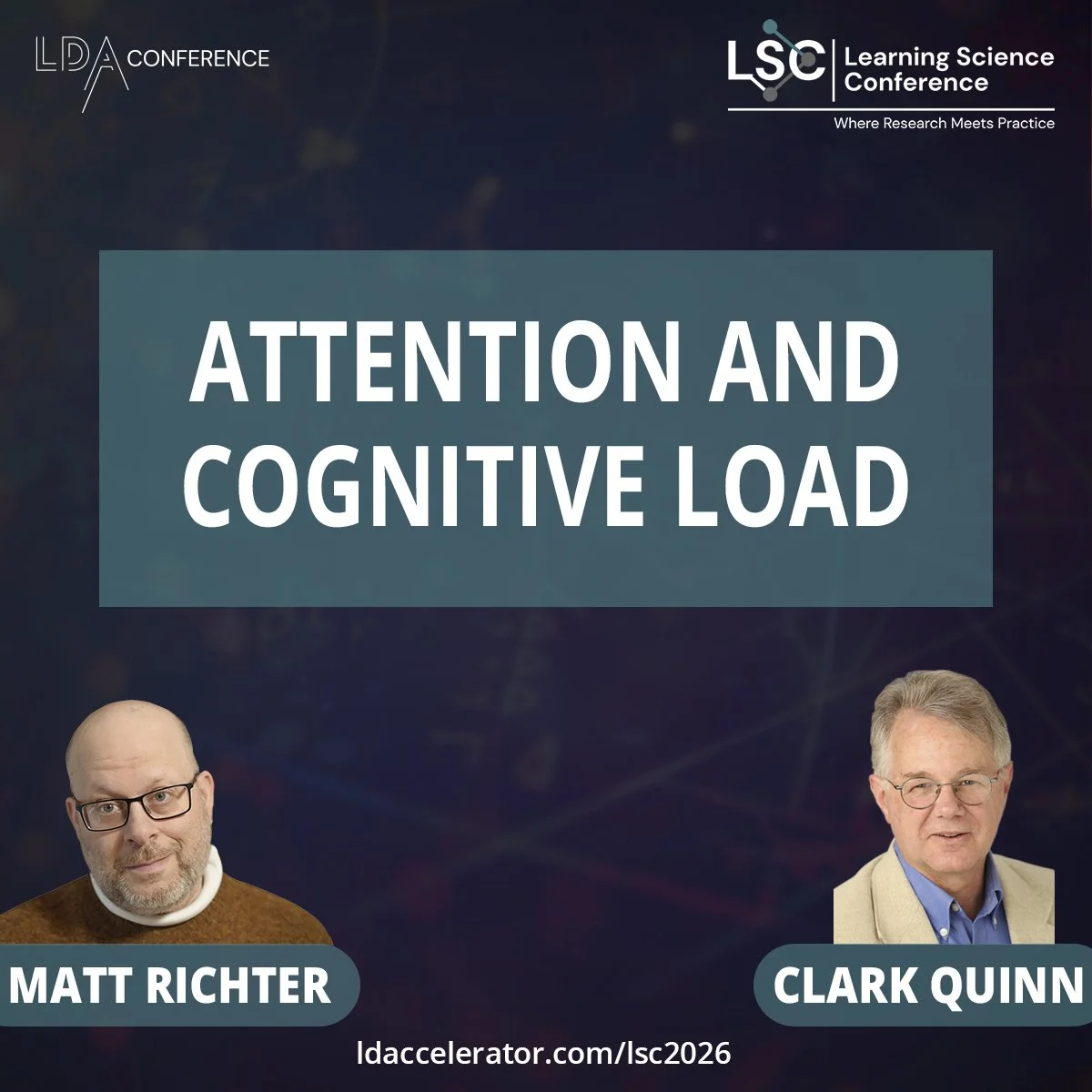
Attention and cognitive load by Clark Quinn and Matt Richter
December 7 at 9:00 a.m. - 10:30 a.m. AND 1:00 p.m. - 2:30 p.m.
What’s in our sensory memory doesn’t come to conscious awareness unless it’s attended to within cognitive load constraints. Which means that if we want folks to learn, we have to make sure we understand this process enough to design for it. In this session, we’ll cover the ways attention - a complex phenomenon - operates, and what the cognitive load constraints mean. You’ll leave with an understanding of how and when to limit content, and how to focus attention appropriately.
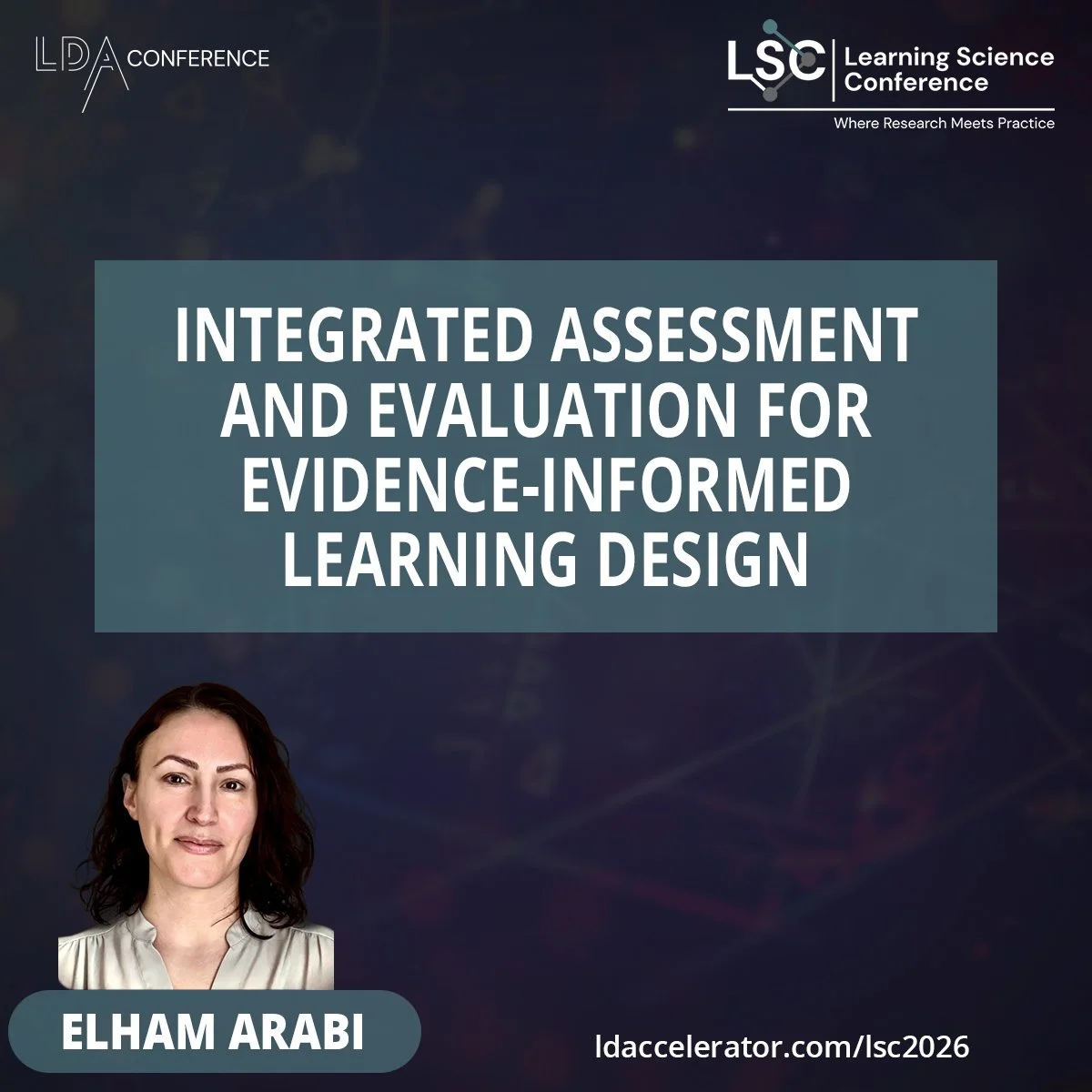
Integrated Assessment and Evaluation for Evidence-Informed Learning Design by Elham Arabi
December 8 at 5:00 p.m. - 6:30 p.m. AND December 9 at 1:30 p.m. - 3:00 p.m.
What do we mean by assessment and evaluation? How can you collect meaningful evidence of performance and use actionable data to strengthen your learning and development efforts? The hybrid sessions are designed for learning leaders, accreditation bodies, training managers, and anyone who is responsible for assessing others or designing assessments that demonstrate performance. In the pre-recorded session, we’ll define assessment and evaluation and explore:
How you collect evidence for performance and competence not just knowledge.
Why you need to move beyond knowledge checks to more rigorous assessment of skills.
How you select the most effective assessment method to produce meaningful, actionable data.
How you use AI to support and facilitate assessment design.
And why you should integrate your assessment with evaluation exercise.
In the live session, we ‘ll work through cases and AI-generated examples that explore the how and why of assessing skills more rigorously. You’ll leave the sessions with handouts, test-design guidelines, and AI prompts that you can use to develop and improve your own assessments.
The Brain’s Brake: How Inhibition Supports Learning and Better Decisions by Nuri Jeong.
December 8 at 9:00 a.m. - 10:30 a.m. AND 12:00 pm - 1:30 p.m.
How does the brain determine what matters, filter distractions, and guide thoughtful decisions? In this session, Dr. Nuri Jeong, neuroscientist and founder of Goals Unhindered, explores inhibition, a fundamental brain process that helps us learn what matters and make strategic decisions. Drawing on her recent research published in Nature, she will introduce the STAR framework and show how these neuroscience principles can inform learning and development through real-world case studies. No background in neuroscience or biology is required.
The OG AI (Authentic Interaction): Exercising Your Facilitation Skills to Support Human Connection by Kat Koppett
December 8 at 7:00 a.m. - 8:30 a.m. AND 2:00 p.m. - 3:30 p.m
Description coming soon…
Before Skills: The Knowledge You Need and The Ways to Get It by Clark Quinn.
December 10 at 11:00 a.m. - 12:30 pm AND 5:00 p.m. - 6:30 p.m.
What is in conscious awareness doesn’t automatically transfer to long term memory to guide performance. On the contrary, we need specific activities that develop our understandings. What, then, do we need to do? In this session we’ll look at the different types of information needed, and talk about how we develop the necessary material to achieve the desired understanding. We’ll look at schemas, mental models, examples, and feedback as critical parts of the necessary learnings.
Performance Objectives: A Framework for Evidence-Informed Design by Dawn Snyder.
December 10 at 7:00 a.m. - 8:30 a.m. AND 1:00 pm - 2:30 p.m.
Objectives are often the first formalized design artifact — and the first step toward a project going off track. Learning professionals rarely skip analysis, but it is often just a pro forma effort: conclusions are drawn and then set aside, never actually shaping the objective they were meant to inform. This session offers a practical framework for closing that gap — strengthening the link between analysis and objective so design decisions are grounded in evidence.
Before Learning Happens: The Role of Perception in Learning by Connie Malamed.
December 10 at 9:00 a.m. - 10:30 a.m. AND 3:00 p.m. - 4:30 p.m
Before learning can happen, information first has to be noticed, organized, and interpreted. In this presentation, you’ll explore how visual and audio perception and working memory shape the way people process instructional media. Using practical examples, you’ll experience the principles of pop-out, perceptual grouping, abstraction, framing, reduced realism, and integrating related information. You’ll see how small design decisions can make important information stand out, how to reduce unnecessary mental effort, and how to help learners make sense of what they see.
Experiment-Led Design by Tom McDowall
December 11 at 7:00 a.m. - 8:30 a.m. AND 1:00 pm - 2:30 p.m.
Improving our practice requires us to keep seeking out new input, new data, and new understanding, and then to try implementing what we find. There's rarely a safe place to do that, because our work tends to be live and real-world, and there aren't many opportunities to practice in low-stakes environments. So many teams never do; they stick with what's safe rather than reaching for the most effective thing they could be doing.
Experiment-led design borrows from agile methodology, product thinking, and performance consulting, and focuses on how we can run rapid workplace experiments to test new ideas with minimal risk. This session takes us from identifying a performance deficit, through creating a hypothesis and an experiment to test it, setting stop conditions and reading the results, to letting the experiment define our next steps.
The Motivation Blueprint: Designing Motivational Environments that Support Learning by Matt Richter
December 11 at 9:00 a.m. - 10:30 a.m. AND 4:30 pm - 6:00 p.m
All too often, we think a motivated learner learns. Unfortunately, the most motivated learner, with an ineffective learning design excitedly learns… well… nothing. Or worse, can even get worse or shut down. Don’t get us wrong, motivation is crucial to the learning process. It is the Willing part of getting Able. But motivation has a different role. Motivation gets your folks into the room. Motivation supports their struggles as they engage what hopefully is an appropriate methodology. And motivation provides the required energy after the program to practice, take in feedback, and continue the work. Based on the 50 years of research behind self-determination theory, this session will:
Explore the different types of motivation that can support or undermine the learning process.
Apply a checklist comprising of the motivational building blocks you can put in place as you design to ensure a more relevant, involving, and structured program.
Discover where exactly motivation plugs in before, during, and after the learning engagement.
Special Sessions
60-90 minutes, one session, all times are in Eastern Standard time.

Networking session facilitated by Kat Koppett
December 7 from 11:00 a.m. - 12:00 p.m.
Description coming soon…

Special Q&A Session: How learning happens with Paul Kirschner
December 8 at 11:00 a.m. - 12:00 p.m.
During the session, Matt Richter will ask Paul Kirschner questions about how learning happens. Taking a high-level view, we will explore the human information processing loop, cognitive load, desirable difficulties, strategies for different learning objectives, types of practice, and more. You will also have the chance to question Paul and get all your questions answered, as well.
Panel on Applied Learning Science with Elevator 9: David Grad, Page Chen, and Elizabeth Dalton - Hosted by Clark Quinn
December 9 at 11:00 a.m. - 12:00 p.m.
Clark Quinn, LDA’s Co-Director, has been serving as Learning Science Advisor to startup elevator9. In the course of this effort to put learning science into action, there have been substantial learnings about taking spacing and making it useful as a followon to traditional training events, leading to measurable impact. In this session, Clark will host co-Founders CEO David Grad and COO Dr. Page Chen, along with Learning Analytics Architect Elizabeth Dalton, and discuss the intent, realizations, and realities of taking the results of research and building a solution that incorporates them. We’ll cover principles, learnings, and outcomes, including the preliminary results from data collection (appropriately anonymized). Come learn lessons that will apply to your own endeavors!
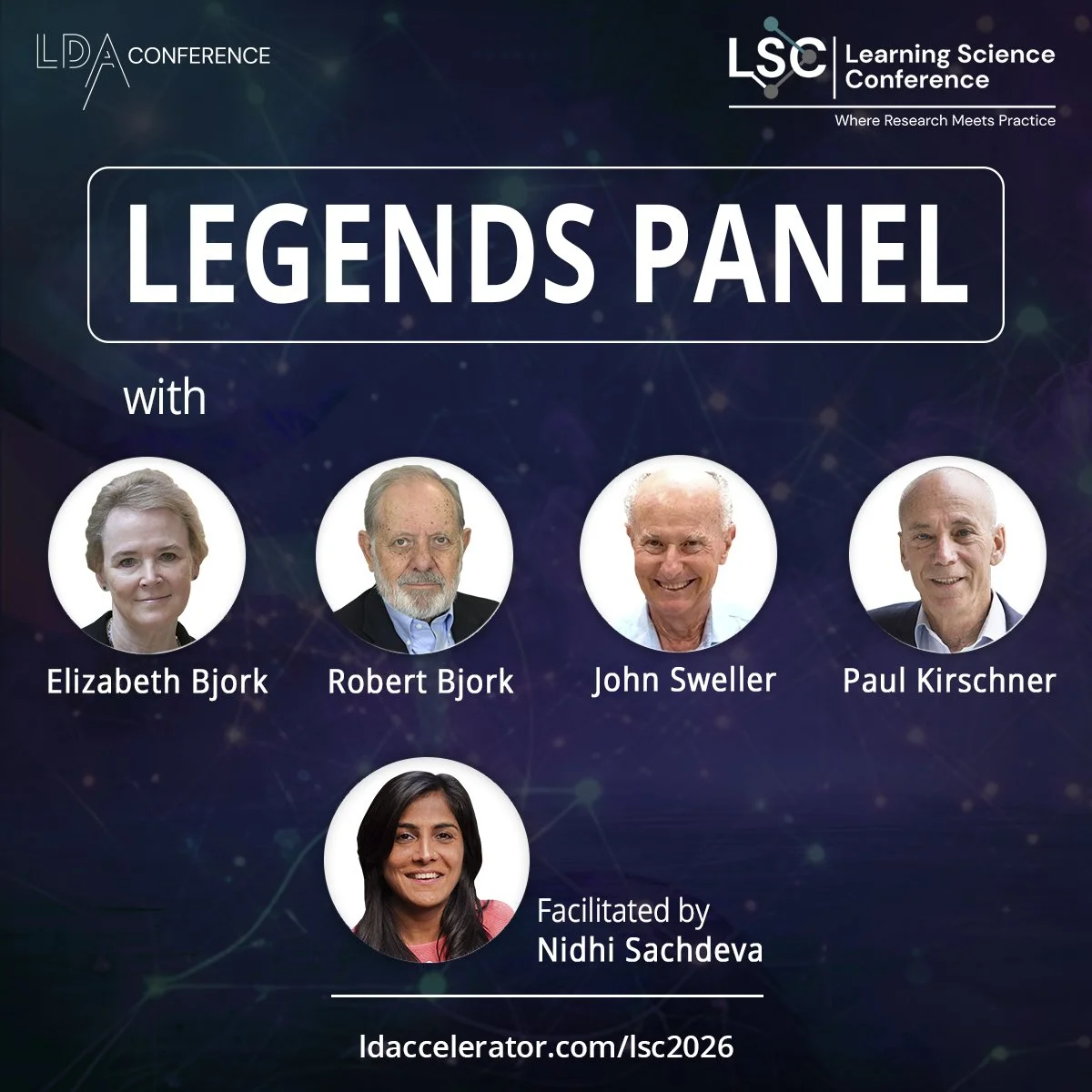
Legends Panel with Elizabeth Bjork, Robert Bjork, John Sweller, and Paul Kirschner facilitated by Nidhi Sachdeva
December 9 at 4:00 p.m. - 5:30 p.m.
What does learning science reliably require? Researchers that do the studies that inform our practices, and translate them into practical guidance. In this session, we’re bringing together four formidable researchers who’s work has been critical to the insights we need on learning science.
The Bjorks, Elizabeth and Robert, have determined the requirements (and coined the phrase) of ‘desirable difficulty’. John Sweller has been responsible for investigating the limits of cognitive load, and helping us understand how to address those limitations. Paul Kirschner has worked with fellow giants in the field such as Richard Clark and Jeroen van Merriënboer to create understandings of learning that guide our pedagogical approaches.
This panel will be moderated by Nidhi Sachdeva, an up-and-coming researcher. A must-see opportunity!
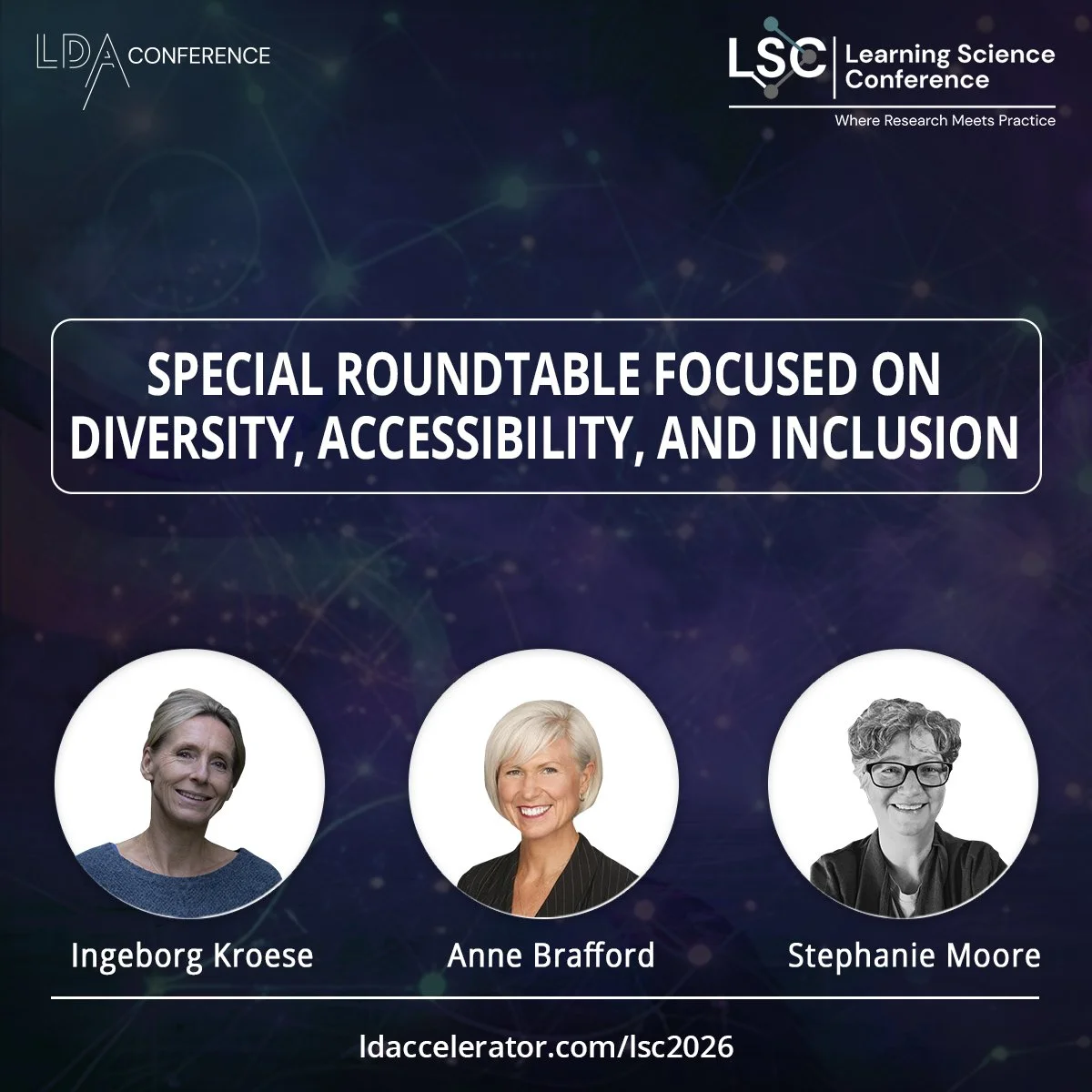
Special Roundtable on diversity, accessibility, and inclusion with Ingeborg Kroese, Anne Brafford, and Stephanie Moore
December 11 at 11:00 a.m. - 12:00 p.m.
Description coming soon…
If you have any schedule-related questions, please contact us at info@ldaccelerator.com.
Professional Development Request Template
Need help getting approval or funding to attend the Learning Science Conference?
We’ve created a ready-to-use Professional Development Request Letter Template to help you make a strong case to your employer.
This editable letter outlines how attending the conference aligns with organizational goals and professional growth. It includes examples of how the conference can contribute to your team’s objectives, along with space to tailor your own justifications.
Use it to:
Request financial support or reimbursement from your employer
Explain how the conference supports your current projects or goals
Demonstrate the value of applying evidence-based learning practices in your work
You can download and customize the document to fit your situation.